

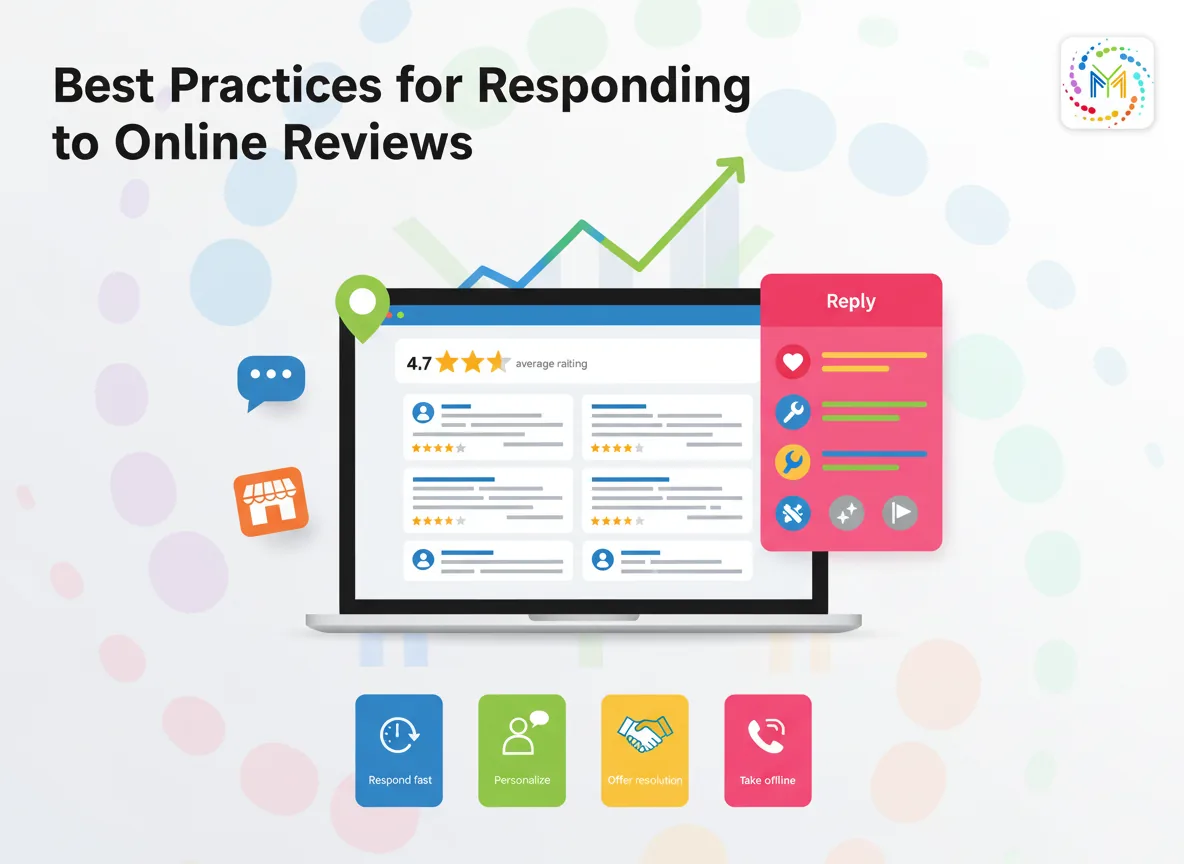
Best Practices for Responding to Online Reviews: How to Effectively Manage Customer Feedback and Enhance Your Reputation
Responding to online reviews means actively engaging with customer feedback on public platforms to influence brand perception, trust, and discoverability. When a business replies to reviews, it signals accountability and responsiveness, which strengthens customer trust and can improve local search visibility through fresh, relevant content and engagement signals. This article explains how to respond to both negative and positive reviews, outlines platform-specific tactics for Google, Yelp, and Facebook, and shows how tools, AI workflows, and KPIs fit into a scalable review response program. Many organizations struggle to convert feedback into operational improvements or to maintain a consistent brand voice at scale; following structured response workflows and measurement practices solves that by creating a feedback loop that improves service and conversion rates. Below you’ll find step-by-step strategies, ready-to-use templates, comparison tables for monitoring and automation tools, and measurement guidance so you can implement an effective online review management process across platforms.
Why Is Responding to Online Reviews Important for Your Business?
Responding to online reviews is the practice of acknowledging customer feedback publicly, explaining how you’ll address issues, and reinforcing positives to influence decision-making and reputation. The mechanism is straightforward: visible replies show prospective customers that you care, they add keyword-rich, fresh content to your business profiles, and they create signals that search algorithms and consumers interpret as active engagement. The specific benefit is three-fold: increased trust, improved local visibility, and higher retention through service recovery—each of which drives conversions. The next paragraphs break down trust mechanisms and key statistics that justify investing in a consistent review response program.
Responding to reviews impacts customer trust by demonstrating empathy and accountability, which often converts hesitant browsers into buyers. When a business publicly acknowledges an issue and outlines a remediation plan, it signals fairness and transparency; this change in perception can recover at-risk customers and persuade new ones. That trust mechanism also feeds into brand perception by showing other readers the company’s standards for service, which compels repeat visits and word-of-mouth advocacy. Understanding how this builds trust leads naturally into the empirical evidence that quantifies the effect of responses on consumer behavior.
Research and industry tracking show measurable consumer behaviors tied to review responses, including higher conversion rates and expectations around response time. For example, recent studies indicate that many consumers read multiple reviews before purchasing and that businesses responding to reviews see improved star ratings and higher booking or purchase intent. Key metrics to watch include the percentage of consumers who consider responses important, typical acceptable response windows, and the average uplift in conversion or lead rates after consistent reply programs. These statistics guide operational targets for response time and frequency, which we cover later when discussing KPIs and dashboards.
Why responding matters in search and discovery:
- Trust and credibility: Replies show accountability and build confidence among prospective customers.
- Search visibility: Fresh, keyword-rich replies can support local SEO and knowledge panel relevance.
- Customer retention: Timely remediation increases the chance a disgruntled customer returns.
These reasons highlight the strategic value of review response and set up practical guidance on how to structure replies and workflows.
How Does Responding to Reviews Impact Customer Trust and Brand Perception?
Responding to reviews impacts trust by signaling that a business listens and acts, and it operates through empathy, transparency, and concrete remediation steps. When replies use personalized language and specific references to the customer experience, they function as public demonstrations of customer care rather than generic PR messages. This mechanism improves brand perception because observers evaluate not just the review but the company’s visible response behavior, which influences overall sentiment and long-term loyalty. Examples of trust-building language include acknowledging the problem, apologizing without deflecting, and offering a clear next step.
Using consistent, human-centered responses also reduces the risk of escalation and demonstrates process maturity to both customers and internal teams. That consistency matters because sporadic or defensive replies can harm reputation more than silence; therefore, standardizing tone and escalation rules helps maintain a reliable public face. Understanding these tone and process components naturally leads to the practical statistics that quantify how much impact response behavior has on purchasing decisions and ratings.
What Are the Key Statistics Behind Review Responses and Consumer Behavior?
Recent industry surveys and consumer behavior analyses show that a large majority of buyers consult online reviews before purchasing and that response behavior affects purchasing decisions. For instance, many consumers expect businesses to respond within a few days and rate responsiveness as a sign of quality service, while businesses that reply regularly often see incremental rating improvements and higher conversion rates. Common benchmarks include response rate targets, acceptable response times, and average rating lift after systematic engagement. These statistics prescribe operational targets and influence how you prioritize monitoring and staffing.
Translating statistics into targets helps organizations set practical goals like maintaining a response rate above a defined threshold or reducing average reply time to a competitive benchmark. Companies that embed these targets in dashboards can then attribute improvements in leads or bookings to the review response program, which closes the measurement loop and supports investment decisions. This linkage brings us to the tactical "how-to" for responding to negative feedback, where structured steps and templates help operationalize these principles.
How to Respond to Negative Online Reviews: Strategies and Examples
Handling negative online reviews requires a consistent, empathetic workflow that acknowledges, apologizes, offers a solution, and—when appropriate—moves the conversation offline. This sequence prevents public escalation and shows readers a commitment to resolution, which often mitigates long-term reputational damage. Start by acknowledging the reviewer’s experience within 24-72 hours, then express empathy and, if appropriate, take responsibility for what went wrong before proposing a concrete remediation. The next content provides best-practice behaviors and shows how to convert complaints into learning opportunities, followed by ready-to-use templates mapped to severity levels.
Best practices emphasize timeliness, de-escalation language, and specific promises for remediation rather than vague assurances. Use the reviewer’s name when available, reference the date or product to show attention to detail, and avoid defensive or legalistic wording. When the issue requires operational change, route the feedback through an internal triage to the relevant team and follow up publicly (e.g., “We’ve passed this to our operations team and will update you within X days”), which creates a transparent feedback loop. Applying these practices consistently increases the chances of converting a critic into a promoter.
Turn negative reviews into growth by extracting root causes and using them to prioritize improvements in service, product design, or training. Set up a triage process where reviews are labeled by category (service, product, logistics) and assigned to owners who track remediation and outcomes. Over time, aggregated themes from negative reviews reveal systemic issues—addressing these can reduce future complaints and improve net promoter scores. Implementing this feedback loop connects review response to product development and customer operations, which enhances the business holistically and reduces repeat incidents.
What to say and how to structure responses:
- Acknowledge the issue and thank the reviewer for feedback.
- Apologize succinctly and take appropriate responsibility.
- Offer a concrete remediation or next step and invite offline contact.
- Follow through and update the public reply with resolution status.
What Are the Best Practices for Addressing Negative Feedback Professionally?
Professional responses to negative feedback should be timely, specific, and grounded in empathy, using language that de-escalates and outlines next steps. Avoid blaming the customer or using legalistic phrasing; instead, acknowledge the experience, apologize if the business is at fault, and provide a clear path to remediation. Keep public replies brief yet informative, then continue detailed problem-solving offline where privacy or complexity demands it. Standardizing tone and escalation thresholds prevents inconsistent replies that could confuse readers or amplify the issue, and training staff on these guidelines ensures continuity.
Incorporate personalization elements—name, date, product—to show attention and follow up with internal process changes when necessary. For sensitive cases, establish escalation criteria that route complaints to senior staff who can authorize refunds or credits, preventing delays that aggravate customers. Regular audits of reply quality and sentiment can also flag tone drift or recurring mistakes, which informs coaching and template updates. Applying these operational practices leads directly to turning complaints into improvements, which the next section examines.
How Can You Turn Negative Reviews into Business Growth Opportunities?
Negative reviews are structured feedback sources that reveal friction points in customer journeys; mining them systematically yields prioritized improvement opportunities. Create a monthly review insights report that aggregates themes, counts occurrences, and links them to operational KPIs like fulfillment time or defect rates. Use these insights to run targeted process improvements—such as retraining staff or adjusting return policies—and measure the effect on subsequent review trends and conversion metrics. Demonstrating measurable changes tied to reviews strengthens internal buy-in and shows customers that feedback leads to real outcomes.
Case examples of growth include product tweaks that reduce complaints or policy clarifications that decrease misunderstandings; each improvement can be highlighted publicly to show responsiveness. Communicate changes in both public replies and broader channels (e.g., product updates), turning a negative interaction into a trust-building story. To help teams act quickly, consider templated escalation workflows that assign owners, deadlines, and follow-up steps—these operational mechanisms close the loop between feedback and business impact.
What Are Effective Apology and Solution Templates for Negative Reviews?
Ready-to-use templates simplify consistent, empathetic replies while leaving room for personalization and factual correction. For minor service issues, a brief acknowledgment and offer to correct suffices; for significant service failures, offer compensation or a concrete remediation plan and request offline contact for privacy. For suspected fake or fraudulent reviews, respond calmly, note that you’re investigating, and reference platform dispute channels without confronting the reviewer. Customize templates with the customer’s name, order details, and a timeline for follow-up to show attention.
| Negative Review Type | Recommended Tone / Elements | Example Response Snippet |
|---|---|---|
| Minor complaint (e.g., delay) | Empathetic, corrective, short remediation | "Thanks for your feedback, [Name]. We’re sorry for the delay—this isn’t our standard. We’ll refund the shipping fee and DM you to confirm details." |
| Service failure (e.g., incorrect order) | Apologetic, offer compensation, offline escalation | "We apologize, [Name]. We’ll replace your order immediately and provide a credit. Please message us so we can organize pickup and delivery." |
| Suspected fake/abuse | Neutral, investigatory, reference platform policy | "Thank you for flagging this. We take claims seriously and will investigate. If you’re affected, please contact us directly so we can help." |
How to Respond to Positive Online Reviews: Encouraging Loyalty and Advocacy
Responding to positive reviews involves thanking the reviewer, personalizing the reply to reinforce behavior, and inviting further engagement that turns satisfied customers into advocates. The mechanism is reciprocity: acknowledgement encourages repeat business and social sharing because customers feel recognized. Publicly amplifying high-value testimonials and encouraging referrals or social shares increases visibility and creates social proof that influences new customers. Below are tactics and scripts to make positive replies both sincere and strategically valuable.
Effective positive responses elevate the customer’s comment by referencing specifics and suggesting next steps, such as joining a loyalty program, sharing a photo, or trying a complementary product. This approach strengthens the bond and directs satisfied customers toward measurable advocacy actions. Use short templates that include the reviewer’s name, a detail from their experience, and an invitation to return or refer—this creates a consistent brand-forward response pattern. The next subsection outlines personalization elements and templates you can adapt.
Positive review tactics include personalizing the reply, inviting advocacy, and amplifying testimonials through other channels. Personalization makes the customer feel seen; advocacy invites like referral incentives or user-generated content prompts spread reach; amplification turns reviews into marketing assets. Each tactic links to a measurable outcome—referrals, repeat purchases, or increased social engagement—so track these outcomes to quantify the return on your engagement program.
- Personalize each thank-you with the reviewer’s name and purchase detail.
- Invite the reviewer to join a loyalty program or refer friends.
- Amplify standout reviews in marketing assets or social posts with permission.
These tactics transform passive praise into active advocacy and measurable business outcomes.
What Are Effective Ways to Thank Customers and Personalize Positive Responses?
Effective thank-you replies reference specific details—product names, dates, or staff members—to show attention and genuine appreciation. Personalization can be as simple as mentioning the service the customer used or thanking them for sharing a photo, which increases the likelihood they’ll engage again. Keep replies concise but meaningful and include a subtle prompt to follow your profiles or join a loyalty channel. Training staff to insert personalized elements into templates ensures responses remain efficient without feeling robotic.
Personalized replies also provide an opportunity to gather permission for repurposing reviews in marketing materials; ask politely and explain how you’ll credit the reviewer. This practice not only amplifies great feedback but encourages others to leave substantive reviews that are more useful for future customers. Maintaining this balance of appreciation and invitation naturally leads into tracking the business benefits of positive responses.
How Can Positive Review Responses Boost Repeat Business and Brand Advocacy?
Positive replies increase retention through reciprocity: when customers feel recognized, they’re more likely to return and refer others. Measure uplift by tracking repeat purchase rates among reviewers who received personalized replies versus those who did not, and monitor referral or voucher redemption rates tied to reply prompts. Using amplified testimonials in marketing campaigns also provides measurable increases in click-through or conversion rates when A/B tested. These quantifiable links justify investment in response programs and connect customer engagement with revenue outcomes.
Documenting these uplifts in dashboards helps allocate resources to the most effective tactics, such as incentivized referral requests versus simple thank-yous. Over time, this data-driven approach refines which reply elements drive the best outcomes and scales advocacy programs across channels.
What Tools and Strategies Can Help Manage and Automate Online Review Responses?
Managing review volume and maintaining brand voice at scale requires a mix of monitoring, response-automation, and analytics tools, plus human oversight. Monitoring tools aggregate reviews across platforms, automation tools can suggest or queue replies, and analytics tools measure sentiment and trends; combined, they form an operational stack that supports timely, consistent responses. The best strategy uses AI to assist, not replace, human judgment: AI drafts suggestions and flags high-priority items for human review, ensuring quality control while improving efficiency. The following content compares tool categories, provides a selection table, and outlines safe automation workflows.
When selecting tools, evaluate capabilities like platform coverage, sentiment analysis accuracy, response-suggestion features, workflow automation, and analytics dashboards. Tools should support human-in-the-loop approval for AI-drafted replies, allow role-based access for escalation, and exportable reports for KPI tracking. Small businesses may prefer simpler aggregators with native reply capabilities, while enterprises often require CRM integration and deeper analytics. Below is a table comparing representative tool types by primary function and best use case to guide selection.
| Tool Category | Primary Function | Best Use Case |
|---|---|---|
| Aggregator / Inbox | Collects reviews from multiple platforms into one queue | SMBs needing centralized monitoring and manual replies |
| AI-assisted Drafting | Suggests reply drafts and tone adjustments | Teams wanting faster replies with human approval |
| Analytics / Dashboard | Tracks sentiment, response KPIs, and trends | Enterprises measuring ROI and linking to CRM |
Which Online Review Management Tools Are Best for Monitoring and Responding?
Choose tools that balance coverage, accuracy, and workflow controls—aggregators for central monitoring, AI assistants for drafting, and analytics platforms for measurement. Critical features include multi-platform aggregation, sentiment tagging, automated priority flags (e.g., low-star reviews), and easy handoff to customer support systems. For small teams, prioritize simplicity and affordability; for larger organizations, require CRM and ticketing integration plus exportable KPIs. Assess vendors by trialing their dashboard usability and the quality of AI-suggested replies under your brand voice.
When evaluating options, use a short checklist: platform coverage, AI suggestion quality, human approval workflow, role-based permissions, and exportable reporting. This checklist leads to safer automation implementations that maintain personalization while improving speed and consistency.
How Can AI and Automation Improve Response Efficiency and Consistency?
AI and automation accelerate response times by drafting context-aware replies and prioritizing critical reviews, enabling teams to handle higher volumes without losing quality. The core guardrails are human-in-the-loop review, tone templates, and escalation rules to prevent inappropriate or inaccurate replies. Automation should handle routine thank-yous and triage, while human agents handle complex complaints, legal issues, or high-value accounts. Implement quality checks such as periodic audits, sentiment drift monitoring, and sample approvals to ensure the automated system preserves brand voice and compliance.
To operationalize this, set rules where AI suggests replies but never posts without an approved reviewer for negative or sensitive cases, and allow auto-posting for simple positive replies if they meet strict template criteria. A practical ethical checklist includes privacy compliance, avoidance of sensitive data, and transparency in how AI is used—these measures keep automation effective and trustworthy.
How to Respond to Reviews on Different Platforms: Google, Yelp, Facebook, and More
Platform-specific norms and policies shape how you should reply: Google favors concise public replies that can influence local SEO, Yelp emphasizes authenticity and has strict moderation rules, and Facebook supports conversational, community-oriented replies. Each platform also differs in visibility and policy constraints; for example, some platforms limit incentives in replies or have specific dispute processes. Tailoring response length, tone, and escalation behavior by platform ensures compliance and maximizes the impact of each reply. Below are best practices and short platform-tailored templates to adapt.
What Are the Best Practices for Responding on Google My Business?
On Google My Business, reply publicly with a brief acknowledgment, a concise apology or thanks, and an offer to resolve offline if necessary, because these replies can influence search visibility and customer decisions. Use keywords naturally related to your services where appropriate (without keyword stuffing), and update replies once issues are resolved to show closure. Avoid including personal or transactional details in public comments and maintain a professional, local-oriented tone. Prioritizing Google replies often yields measurable benefits in local searches and knowledge panel trust.
How Should You Tailor Responses for Yelp and Facebook Reviews?
Yelp prioritizes authenticity and discourages solicitations or incentives for reviews, so craft replies that are candid, non-promotional, and focused on service recovery. For suspected fake reviews, follow Yelp’s dispute mechanisms and keep public replies neutral and investigatory. Facebook reviews often read like social posts; replies can be more conversational and community-focused, encouraging continued engagement with calls to action like “message us” or “share your photo.” Tailor tone and length to each platform’s norms to maximize credibility and avoid policy violations.
How Do You Measure the Success of Your Online Review Response Strategy?
Measuring success requires tracking KPIs that connect response activity to reputation and business outcomes, such as response rate, average response time, rating trend, sentiment score, and conversion lift. Define each metric, set realistic targets, and monitor them in dashboards that combine review data with sales or lead metrics to show attribution. Consistent measurement enables you to refine workflows, justify resources, and demonstrate ROI for review response investments. The next paragraphs define core KPIs and explain how to operationalize feedback analysis across teams.
| KPI | Definition | How to Calculate / Target Benchmark |
|---|---|---|
| Response Rate | Share of reviews with a reply | (Number of replied reviews / Total reviews) × 100; target 80%+ for core channels |
| Average Response Time | Mean time between review posting and first reply | Sum of response times / Number of replies; target <48 hours for urgent platforms |
| Rating Trend | Change in average star rating over time | Compare rolling 90-day average star rating; aim for steady upward or stable trend |
| Sentiment Score | Aggregate positivity of review text | Use sentiment analysis score normalized to 0–100; target improvement quarter-over-quarter |
These KPIs create a measurement backbone that enables attribution and continuous improvement. Embedding them in dashboards and weekly reports aligns teams around clear objectives and informs staffing or automation needs.
What Key Performance Indicators Track Review Management Effectiveness?
Key indicators—response rate, response time, rating trend, sentiment score, and conversion lift—translate review management into measurable business outcomes. Define reporting cadence (weekly for operational KPIs, monthly/quarterly for trend KPIs) and set tiered targets by platform based on volume and importance. Use exported reports to show before/after comparisons when you change workflows or implement automation, which supports investment cases. Tracking these indicators allows precise diagnostics: long response times point to staffing issues, while stagnant ratings may indicate product or service problems.
How Can Businesses Use Feedback Analysis to Improve Customer Service and Reputation?
Feedback analysis converts unstructured review text into actionable insights by tagging themes, assigning owners, and tracking remediation outcomes. Implement a triage playbook that classifies reviews by severity and theme, routes them to responsible teams, and records resolution status and timing. Close the loop by updating public replies with the resolution and by reporting trending issues to product or operations owners; this practice demonstrates accountability and prevents repeat problems. Regularly tying feedback trends to operational KPIs, such as defect rates or customer churn, shows how review response drives tangible improvements.
To support operationalization, create dashboards that combine review trends with internal metrics and use them in cross-functional review meetings to prioritize fixes. For an external audit of your review response program or custom templates and dashboards that integrate review response with SEO and reputation management, Minding Your Media offers consultations to design a tailored strategy and measurement framework.