

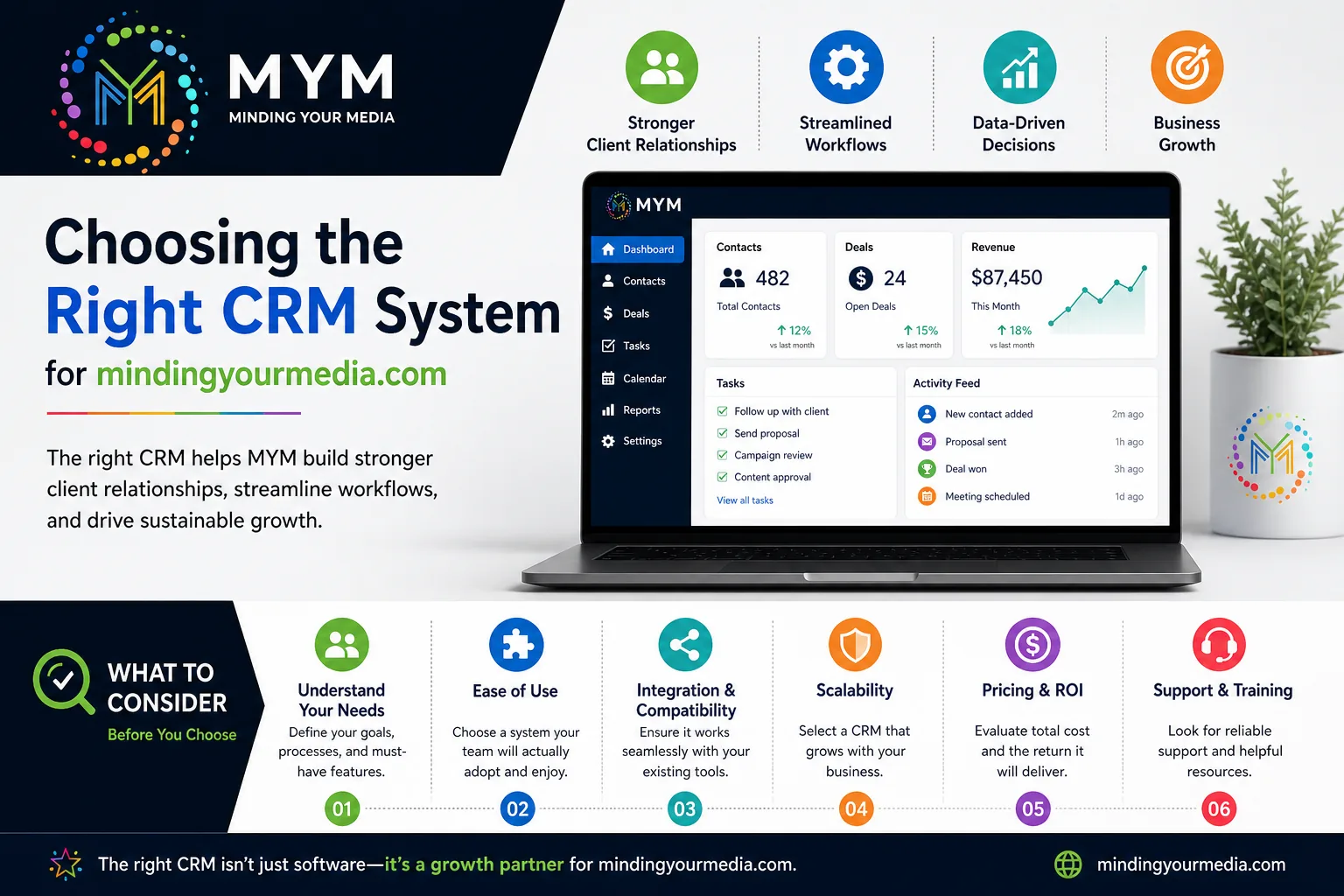
Choosing the Right CRM System: A Complete CRM Selection Guide for Digital Marketing Success
Choosing the right customer relationship management (CRM) system is a strategic decision that directly affects lead generation, campaign personalization, and long-term marketing ROI. This guide explains what a CRM is in the context of digital marketing, how it centralizes customer data to enable targeted campaigns, and why the right system accelerates conversion and retention. Readers will learn which features matter most for marketing and sales teams, a repeatable selection framework, an implementation HowTo that covers data migration and adoption, vendor comparisons tailored to marketing use cases, and a practical approach to evaluating cost and ROI. The guide emphasizes AI-enabled capabilities, CRM analytics for marketing ROI, and concrete steps to pilot and measure results so teams can move from assessment to measurable outcomes. By the end you’ll have a prioritized checklist and decision path to map your business goals to CRM capabilities and buyer criteria.
Why Is Choosing the Right CRM System Critical for Digital Marketing?
A CRM system is the central business software that organizes customer interactions, enabling marketing teams to execute personalized campaigns at scale and track performance across the customer journey. It works by consolidating lead and customer data, applying segmentation and scoring to prioritize outreach, and feeding analytics back into campaign optimization processes. The result is clearer attribution, faster lead response, and improved lifetime value through targeted retention programs. Choosing the wrong CRM can fragment data and slow automation, so evaluating fit against marketing goals and data architecture is essential. Understanding these stakes leads into how CRMs specifically improve lead generation and retention for marketers.
CRM systems improve lead capture and nurturing by automating data enrichment, segmentation, and timely follow-ups that convert inbound interest into revenue. When CRM workflows tag leads and trigger nurture sequences, marketing teams deliver the right message at the right moment, increasing conversion rates and reducing time-to-contact. Automated routing and lead scoring also ensure sales focuses on high-value prospects while marketing measures campaign effectiveness through analytics. These mechanisms show why a marketing-first CRM strategy must prioritize data quality and workflow automation to sustain growth.
How Does a CRM Improve Lead Generation and Customer Retention?
A CRM improves lead generation and retention by automating capture, enrichment, and personalized nurture sequences that increase conversion and repeat purchase rates. It typically ingests form fills, ad clicks, and behavioral events, then applies segmentation and lead scoring to route prospects to the right campaign or sales rep. This automated pipeline ensures faster follow-ups and higher-quality handoffs, which improves lead-to-opportunity conversion. For retention, CRMs enable lifecycle campaigns—re-engagement, cross-sell, and churn-prevention flows—that use customer history and predictive signals to trigger targeted outreach. Effective setup requires mapping touchpoints, defining scoring thresholds, and validating that automated actions match your marketing goals.
This operational value leads directly to measurable improvements in marketing ROI, which is the next essential consideration for marketing leaders deciding on CRM investments.
What Are the Key Marketing ROI Benefits of Using a CRM?
A CRM delivers measurable marketing ROI by lifting conversion rates, reducing customer acquisition cost (CAC), and increasing customer lifetime value (LTV) through improved personalization and attribution. By tying campaign touchpoints to outcomes, teams can quantify uplift from targeted segments and optimize budget allocation. Analytics and reporting within a CRM make it easier to run experiments—A/B tests on nurture sequences, channel spend shifts, and offer optimization—to find the highest-return tactics. For example, improving lead response time by even a few hours through automated routing often yields notable conversion gains. Clear metrics and attribution help justify the CRM investment and shape ongoing marketing strategy.
Evaluating Digital Marketing ROI with CRM and Automation Tools
The integration of analytics platforms, marketing automation tools, and CRM systems empowers businesses to measure and optimize digital marketing ROI. Understanding the capabilities of these integrated systems is crucial for businesses seeking to enhance their marketing effectiveness and achieve a better return on investment.
Evaluating ROI in digital marketing campaigns: metrics, measurement, and insights, KK Ramachandran, 2023
These ROI benefits underline which feature sets to prioritize when evaluating CRM capabilities for marketing and sales alignment.
What Are the Essential CRM Features to Consider for Marketing and Sales Teams?
Essential CRM features for marketing and sales include robust contact and account management, marketing automation, integration capabilities, analytics and reporting, and AI-enabled insights. Contact management centralizes profile, behavior, and transaction data so campaigns target the correct segments. Marketing automation provides workflows, email sequences, and triggered campaigns to convert and retain customers. Integrations with ad platforms, CMS, and analytics tools preserve a single customer view and enable cross-channel orchestration. AI features—predictive scoring and content personalization—augment human decisions to prioritize outreach and tailor messages at scale. Understanding how each capability maps to marketing outcomes helps prioritize vendors during selection.
Feature comparisons clarify capability-to-benefit relationships so teams can prioritize requirements before vendor shortlisting.
Different CRM features support specific marketing outcomes and operate through distinct mechanisms:
| Feature | Capability | Marketing Benefit |
|---|---|---|
| Marketing Automation | Email sequences, triggered workflows, drip campaigns | Improved lead nurturing and higher conversion rates |
| Lead Scoring | Behavioral and demographic rules, predictive scoring | Prioritized outreach and efficient sales handoffs |
| Integrations & APIs | Native connectors, webhooks, middleware support | Unified customer view and cross-channel attribution |
| Reporting & Analytics | Dashboards, cohort analysis, attribution models | Actionable insights and optimized media spend |
This table highlights that marketing automation and scoring directly impact conversion, while integrations and analytics drive attribution and optimization. Prioritizing features based on desired outcomes reduces selection risk.
Which CRM Features Support Lead Management and Sales Automation?
Lead management and sales automation features include lead capture, deduplication, scoring, assignment rules, and pipeline visualization that streamline conversion from inquiry to revenue. Lead capture mechanisms ensure data flows from forms and ad platforms into a centralized record, while deduplication preserves data integrity so outreach is not duplicated. Scoring algorithms—rule-based or predictive—rank prospects and trigger alerts or routing to sales reps based on defined thresholds. Sales automation then enforces consistent follow-ups, creates tasks, and updates opportunity stages, which reduces manual work and shortens sales cycles. Pipeline visualization provides transparency into deal stages and conversion bottlenecks to inform both marketing and sales interventions.
These operational features are often the first checkpoints when mapping business goals to product capabilities in the vendor evaluation process.
How Do AI and Marketing Automation Enhance CRM Capabilities?
AI and marketing automation extend CRM value by predicting lead quality, personalizing content at scale, and recommending next-best actions that increase conversion efficiency. Predictive lead scoring uses historical outcomes and behavioral patterns to surface high-probability prospects, saving time and improving win rates. Generative content tools can draft personalized email variants or landing page copy, reducing creative friction for targeted campaigns. Automated analytics identify anomalies, recommend segmentation changes, and trigger campaigns based on predicted churn risk. Ethical use requires clear data governance, consent management, and validation of model outputs to avoid bias and ensure privacy compliance. Implementing these features typically needs clean historical data and integration with existing martech to generate reliable recommendations.
AI-Enabled Personalization in CRM for Customer Acquisition
Customer relationship management (CRM) became an important topic in both research and companies due to technological advancements such as the World Wide Web and innovations in customer database and data warehouse technologies. In today's competitive business landscape, where companies are seeking new ways to differentiate themselves from competitors, one strategy is to implement an individualized CRM strategy that treats customers as unique individuals and relies on effective personalization. This thesis explores the role of personalization in CRM and how AI can enhance personalization. Especially generative AI’s effect on customer acquisition through creation of personalized content will be examined.
Leveraging ai-enabled personalization in customer relationship management, 2024
AI-driven automation amplifies marketing efforts when paired with strong data practices and governance.
How Do You Select the Best CRM Software for Your Business Needs?
Selecting the best CRM begins with a structured, goal-driven evaluation that maps marketing objectives to required capabilities, integration needs, scalability, and user adoption strategy. Define measurable goals—lead volume targets, conversion uplift, improved attribution—then translate each into must-have features. Assess how a CRM will integrate with ad platforms, analytics, CMS, and any customer data platforms to maintain a single customer view. Pilot testing with a representative user group and real data validates assumptions about workflows and adoption. The selection process should culminate in a scorecard that weights technical fit, cost, vendor support, and implementation risk.
A stepwise checklist makes these decisions repeatable and reduces vendor selection bias.
Follow these five steps to choose a CRM that aligns with digital marketing goals:
- Define clear marketing and sales objectives that the CRM must support.
- Map objectives to required features and integration points for your tech stack.
- Shortlist vendors using a capabilities scorecard and prioritize based on fit.
- Run a time-boxed pilot with sample data and representative users to validate workflows.
- Evaluate total cost of ownership, support, and scalability before final procurement.
This decision framework ensures choices come from measurable criteria rather than feature lists alone and naturally leads into selecting goals that should guide your CRM choice.
At this stage, organizations ready for assistance can engage external consultants. Minding Your Media offers a consultative CRM selection approach that helps businesses map digital marketing objectives to vendor capabilities and run comparative demos. For teams seeking tailored evaluation and vendor comparisons, Minding Your Media provides consultations and services designed to convert assessment into actionable vendor shortlists and pilot plans.
What Digital Marketing Goals Should Guide Your CRM Choice?
Your primary digital marketing goals—lead generation, retention, account-based marketing, or improving campaign attribution—should directly determine the CRM features you prioritize. For lead generation, prioritize capture, automation, and multi-channel integration; for retention, emphasize customer journeys, lifecycle campaigns, and churn prediction. Account-based marketing requires robust account hierarchies, firmographic enrichment, and coordinated sales-marketing workflows. Attribution and analytics goals push requirements toward flexible reporting, multi-touch attribution models, and event-level data capture. Mapping each goal to specific capabilities and example KPIs makes vendor evaluation objective and actionable.
This goal-to-feature mapping clarifies integration priorities and the types of pilots to run during selection.
How Important Is CRM Integration with Your Existing Marketing Tech Stack?
Integration is essential: a CRM that cannot synchronize reliably with email platforms, ad networks, CMS, analytics, and CDPs will fragment the customer view and weaken campaign orchestration. Essential integration checks include native connectors, API availability, middleware support, and real-time data sync options. Data synchronization strategies should define master records, conflict resolution, and field mappings to preserve data lineage and avoid inconsistent attributes. Common pitfalls include assuming turnkey integrations when custom mapping is required, underestimating middleware costs, and neglecting event schema alignment. Planning integrations early reduces surprises during implementation and preserves analytic fidelity.
Careful integration planning informs the scope of migration and the next set of implementation steps necessary for successful adoption.
Why Are Scalability and User Adoption Critical in CRM Selection?
Scalability and adoption determine whether a CRM remains useful as your business grows and evolves; a system that cannot expand in data volume, user count, or features will become a bottleneck. Scalable solutions offer flexible licensing, modular add-ons, and predictable performance with large datasets. Equally important is user adoption: role-based training, internal champions, and phased rollouts increase sustained usage. Adoption tactics include playbooks for common workflows, in-app guidance, and metrics to measure active users and feature usage. Prioritizing scalability and adoption during selection protects your investment and ensures the CRM accelerates rather than impedes growth.
Addressing scalability and adoption needs prepares you for the implementation roadmap covered next.
What Are the Key Steps in CRM Implementation for Successful Adoption?
A structured implementation roadmap starts with planning and data audit, proceeds through configuration and migration, and concludes with training, pilot launch, and continuous improvement. Begin with a cross-functional project team that defines scope, success metrics, and governance. Data migration requires cleansing, field mapping, and test migrations to validate integrity. Configuration focuses on automations, scoring rules, and reporting aligned to marketing and sales processes. Finally, launch with a pilot cohort, measure adoption KPIs, and iterate on workflows based on user feedback to drive long-term value. This phased approach reduces disruption and increases the chance of successful adoption.
Practical steps for migration and training make the difference between a shelved implementation and measurable process improvement.
For organizations that prefer external support during implementation, Minding Your Media provides implementation and integration assistance. To provide useful information about digital marketing services and solutions, and to generate leads by encouraging businesses to contact them for consultations and services. Their approach offers hands-on migration support and integration planning to accelerate time-to-value and minimize risk.
What Are the Best Practices for Data Migration and System Integration?
Data migration succeeds when teams first audit and cleanse source records, then create precise field mappings and validation rules before executing any bulk transfers. Start by profiling data quality—duplicates, missing key fields, and inconsistent formats—and apply cleansing routines to normalize records. Create a mapping document that preserves data lineage and handles custom fields, then run incremental test migrations to verify mapping accuracy. Post-migration, use reconciliations and spot checks to confirm record counts, field mappings, and associated activities. Planning rollback criteria and maintaining a source-of-truth policy ensure you can recover if unexpected issues arise during cutover.
These data practices reduce friction during go-live and prevent downstream analytics errors.
This technical validation prepares the organization for user training, which is critical to adoption and will be discussed next.
How Can Training and User Support Improve CRM Adoption Rates?
Training and ongoing support convert capability into daily practice by equipping users with role-based workflows, playbooks, and accessible help resources that match their responsibilities. Role-based training tailors sessions to marketing, sales, and operations so each group learns relevant automations and reporting. Supplement live training with short playbooks, recorded videos, and in-app tips that users can reference during daily tasks. Establish clear support channels—designated champions, regular office hours, and metrics-driven feedback loops—to monitor adoption KPIs such as active user rate and feature utilization. Incentivize early adopters and capture success stories to build momentum across teams.
Sustained training and support close the loop between technical implementation and tangible performance improvement.
Implementation steps naturally lead into assessing which vendor platforms best match business size and marketing needs.
Which CRM Systems Are Best for Small to Enterprise Businesses in Digital Marketing?
Choosing a CRM depends on business size, marketing complexity, and required integrations; small businesses often prioritize ease-of-use and bundled marketing tools, while enterprises focus on scalability, security, and partner ecosystems. A useful evaluation contrasts marketing automation strength, integration breadth, analytics capabilities, and total cost of ownership for each candidate. Consider vendor-agnostic, marketing-oriented criteria such as out-of-the-box nurture flows, available connectors, API flexibility, and support for AI-powered features. Pilot key scenarios—lead capture, cross-channel attribution, and campaign personalization—to validate suitability for your use case. Below is a concise vendor-by-vendor comparison tailored for marketing evaluations.
This comparative view helps shortlists that align with both immediate marketing needs and long-term growth plans.
| CRM Product | Marketing Strength | Best Use Case / Business Size |
|---|---|---|
| Salesforce | Enterprise-grade integrations, advanced analytics | Large enterprises needing customization and ecosystem partners |
| HubSpot | Bundled marketing tools, ease of use | Small to mid-market teams seeking quick time-to-value |
| Zoho CRM | Cost-effective feature set and extensibility | Small businesses and growing companies on tighter budgets |
This vendor table highlights trade-offs between deep customization and ease of deployment so teams can map selections to organizational capacity and budget.
How Do Salesforce, HubSpot, and Zoho CRM Compare for Marketing Needs?
Salesforce offers extensive integration options and advanced analytics, making it suitable for large organizations that need customization and platform extensibility. HubSpot prioritizes an integrated marketing suite with user-friendly automation and built-in attribution tools that accelerate go-to-market for small to mid-sized teams. Zoho CRM emphasizes affordability and modularity, providing core automation and integration features for businesses with tighter budgets. Each platform has trade-offs in implementation complexity, ongoing maintenance, and licensing models that marketers must weigh against their technical resources and growth plans. Running parallel pilots that simulate real campaign workflows helps reveal hidden TCO and operational fit.
This vendor comparison helps teams decide whether deep customization or rapid deployment is the higher priority for their marketing strategy.
What Are the Unique Benefits of CRM Systems for Small Businesses?
CRMs tailored to small businesses prioritize simplicity, bundled marketing features, and predictable pricing to lower barriers to adoption. Out-of-the-box automation templates and prebuilt connectors reduce setup time and allow marketing teams to launch campaigns quickly without heavy developer involvement. Cost-effective plans often include essential reporting and contact management that scale until more advanced needs emerge. Small-business best practices include starting with a minimum viable CRM configuration, tracking a focused set of KPIs, and upgrading modules as adoption and complexity grow. This staged approach keeps initial costs manageable while unlocking meaningful lead management improvements early.
Small businesses that focus on essential workflows and measured expansion typically realize faster ROI from CRM investments.
How Do You Evaluate CRM Cost, ROI, and Budgeting for Your Business?
Evaluating CRM cost and ROI requires understanding pricing models, implementation and ongoing operational costs, and the expected uplift in marketing outcomes that translate into revenue. Typical cost components include subscription or per-user fees, add-on modules for automation and analytics, integration or middleware costs, and implementation and training expenses. Estimating ROI involves projecting incremental revenue from conversion improvements, reductions in CAC, and LTV gains attributable to CRM-enabled programs. A simple ROI formula compares incremental gross margin attributable to CRM improvements against total cost of ownership over a defined payback period. Budgeting for contingency and phased rollouts reduces financial risk and aligns spending with measurable milestones.
A structured pricing and ROI table clarifies trade-offs between upfront investment and expected performance gains.
| Pricing Model | Typical Cost Components | Impact on TCO and ROI |
|---|---|---|
| Subscription (per-user) | Monthly user fees, add-on modules, support tiers | Predictable OPEX; ROI depends on utilization rates and feature uptake |
| Tiered Plans | Feature tiers, limits on contacts/automations | Lower entry cost but may require upgrades as volume grows |
| Enterprise Licensing | Custom pricing, premium support, implementation fees | Higher upfront cost, better for large-scale integrations and security needs |
This table helps decision-makers anticipate where costs accrue and how pricing choices affect long-term ROI.
What Are the Typical CRM Pricing Models and Licensing Costs?
CRM pricing commonly follows subscription per-user models, tiered plans with feature gates, and enterprise licensing with bespoke pricing for large deployments. Per-user subscriptions make costs transparent but scale linearly with headcount; tiered plans offer lower entry points but may increase TCO if you exceed included limits for contacts or automations. Enterprise licensing often bundles support and customization but carries higher implementation and governance costs. Hidden costs to watch for include middleware fees for integrations, data storage charges, custom development, and ongoing training or change management. Accounting for these elements in your budget allows for a realistic total cost assessment and better ROI planning.
Understanding these pricing mechanics guides procurement conversations and prepares procurement for negotiation and future scaling.
How Is CRM ROI Measured in Digital Marketing Campaigns?
CRM ROI in marketing is measured by linking CRM-driven improvements—such as higher conversion rates, reduced CAC, and improved LTV—to revenue gains, then comparing those gains to the total cost of ownership. Key metrics to track include conversion rate lift, average deal value, time-to-close, CAC reduction, and retention improvement. A simple ROI example: incremental gross profit from conversion lift divided by CRM TCO over a 12-month period yields a payback ratio for decision-makers. Attribution models and multi-touch analytics are essential to accurately apportion uplift to CRM-driven activities versus other channels. Establishing clear baselines before implementation ensures post-launch measurements reflect true CRM impact.
Hyper-Personalization: AI-Enabled Customer Experiences in Marketing
This chapter facilitates marketers to use AI-enabled personalization to create hyper-personalized customer experiences. AI-enabled personalization can adapt to different levels by enabling adaptive content, functionality, and interaction in real-time in response to customer behavior and preferences.
Hyper-personalization: an AI-enabled personalization for customer-centric marketing, D Desai, 2022
With measurable KPIs, teams can iterate on workflows and justify continued investment in CRM capabilities.
- Cost Components to Track: subscription fees, integrations, implementation, training, storage.
- Key ROI Metrics: conversion rate change, CAC, LTV, time-to-close.
- Sample Calculation: (Incremental Revenue × Gross Margin) / CRM TCO = ROI payback ratio.
These practical metrics enable finance and marketing to agree on outcomes and assess vendor value objectively.
To provide useful information about digital marketing services and solutions, and to generate leads by encouraging businesses to contact them for consultations and services. If you’d like a vendor-agnostic comparative demo or help quantifying expected ROI for your specific marketing programs, Minding Your Media offers evaluation services and demo facilitation to assist in decision-making.
What Are the Typical CRM Pricing Models and Licensing Costs?
A focused look at pricing models clarifies expected recurring and one-time expenses and helps teams plan phased adoption and upgrades. Subscription and tiered plans are common, with additional costs for advanced automations, analytics modules, and premium support. Implementation fees can vary by complexity and whether data migration and custom integrations are required. Ongoing costs include training refreshers and expansion of user licenses as teams grow. Budgeting for these elements upfront enables realistic TCO and avoids surprises during scale-up.
This completes our guided paths to evaluate costs and expected returns, equipping teams to select and implement the right CRM for marketing success.