

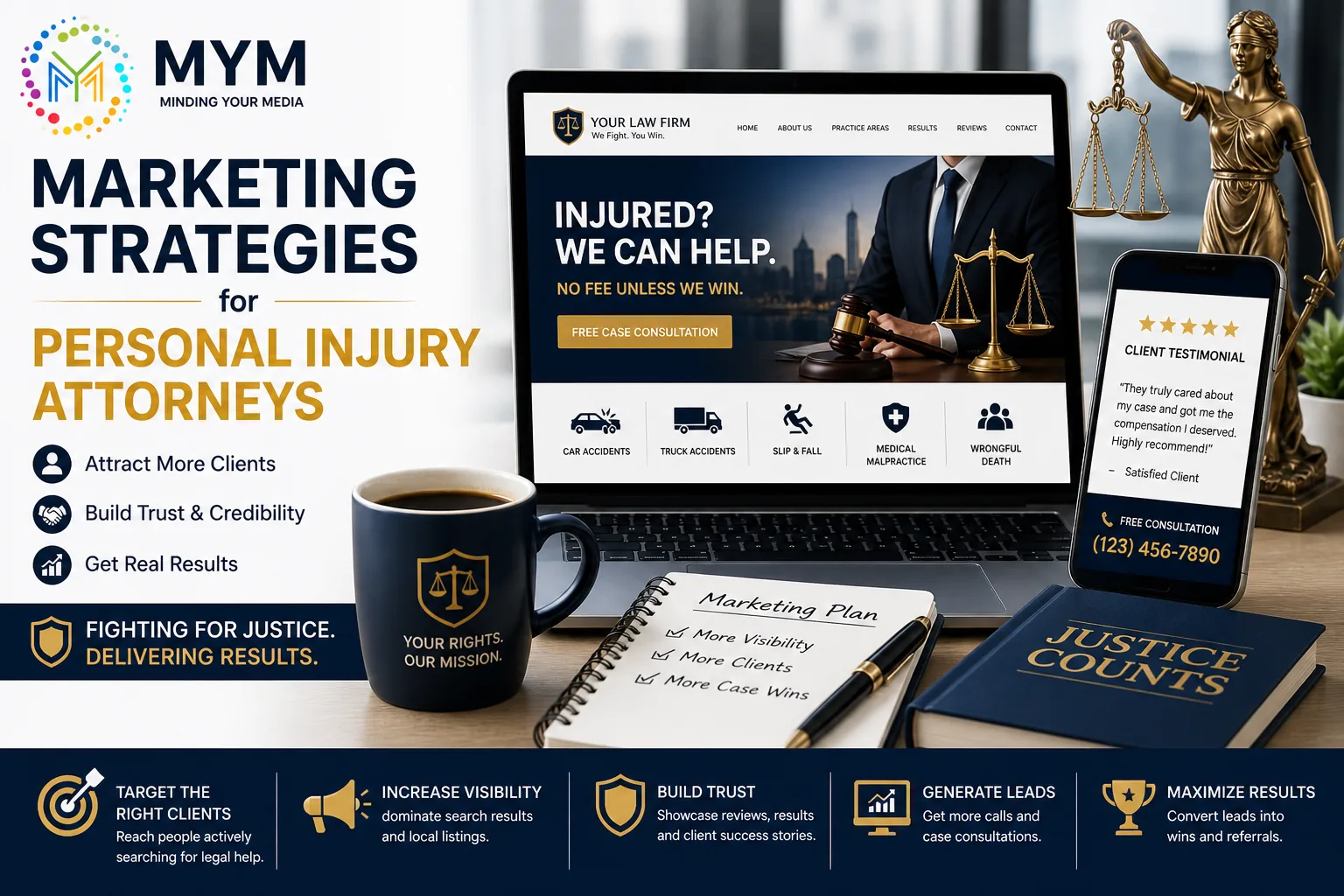
Effective Personal Injury Lawyer Marketing Strategies for Client Acquisition and Growth
Personal injury attorney marketing focuses on converting high-intent prospects into retained clients through targeted digital and offline channels, measurable intake processes, and reputation building. This guide explains how strategic law firm marketing drives client acquisition and growth by aligning search intent, paid outreach, conversion-optimized landing pages, and trust signals to increase qualified leads. Many firms struggle with inconsistent lead flow or poor lead-to-client conversion; we address practical tactics—SEO, PPC, social, local listings, and traditional media—so firms can prioritize channels that scale. Readers will learn a channel comparison, SEO and local implementation steps, 2024 trends including AI and privacy implications, paid-ad strategies with realistic budgeting guidance, measurement frameworks for CAC and ROI, and reputation-building workflows. Throughout the article we reference lawyer-specific compliance considerations and provide checklists, templates, and EAV-style comparison tables to support execution for personal injury attorney marketing and law firm SEO initiatives.
What Are the Most Successful Marketing Strategies for Personal Injury Attorneys?
Successful personal injury attorney marketing combines inbound and outbound channels to match claimants at different moments of intent, balancing speed-to-lead with lead quality. Channels that perform well include organic search for high-intent terms, targeted PPC for immediate visibility, social and video for awareness and proof, referral partnerships for high-quality cases, and select traditional media for brand reach. Each channel delivers different timelines, costs, and conversion profiles, so firms should prioritize based on budget, geographic footprint, and case types. The following ranked list summarizes the best channels and why they matter for client acquisition.
Top channels for PI client acquisition and a quick why/how summary:
- SEO / Organic Search: Long-term, high-quality leads from legal-intent queries; strong ROI when paired with intake optimization.
- PPC / Paid Search: Immediate visibility for urgent searches; predictable lead volume with proper bidding and compliance.
- Social & Video: Builds trust and educates prospects; supports retargeting funnels and referral amplification.
- Referral & Partnerships: High-intent, high-conversion leads from medical providers or past clients; lower volume but strong LTV.
- Traditional Media (TV/Radio/Billboards): Broad awareness and brand recall; best for large firms with significant budgets and multi-channel attribution.
These channels should be combined for a balanced funnel that captures intent, nurtures interested prospects, and converts through an optimized intake process. The next section discusses how digital tactics—especially SEO—improve visibility and deliver a steady organic pipeline for firms.
Different marketing channels vary by cost, speed-to-lead, quality, and compliance risk; the table below summarizes these trade-offs to guide investment decisions.
| Channel | Typical Cost Profile | Speed-to-Lead | Lead Quality | Compliance Risk |
|---|---|---|---|---|
| SEO / Organic | Low-to-moderate ongoing | Medium-term (weeks–months) | High | Low |
| PPC / Paid Search | Moderate-to-high per-click | Immediate | Medium–High | Medium |
| Social & Video Ads | Moderate, scalable | Short-term (days–weeks) | Medium | Medium |
| Referrals / Partnerships | Low direct cost | Variable | High | Low |
| Traditional Media | High production & placement | Short- to medium-term | Variable | Low–Medium |
How Does Digital Marketing Drive Client Acquisition for Personal Injury Lawyers?
Digital marketing drives client acquisition by matching the searcher’s legal intent to specific content and conversion paths that qualify prospects quickly. Search engines surface legal-intent queries that firms can capture through targeted service pages, while paid search places firms at the top of results for urgent queries; both feed landing pages designed to convert with triage forms and fast contact options. Retargeting and email nurture recover visitors who did not convert immediately and move them along a funnel from awareness to consultation. Coordinated measurement—linking calls, form fills, and CRM outcomes—ensures channels are optimized for lead-to-client conversion rather than raw volume.
Mechanically, the funnel functions as ad or search touch → intake landing page → intake triage → consult → retain, and each step should be instrumented for attribution. The next subsection explains when and how traditional channels complement digital strategies for broader reach.
Which Traditional Marketing Methods Still Work for Personal Injury Law Firms?
Traditional methods such as TV, radio, and billboards remain effective for large-scale brand visibility and can drive direct response when paired with tracking mechanisms. For firms with the budget to run mass-market creative, television and radio can prime name recall that increases search volume and direct traffic; incorporating unique promo codes, dedicated phone numbers, or specific landing pages enables attribution. Billboards and outdoor advertising work well in concentrated markets or near hospitals and courts, especially when messaging emphasizes immediacy and contact routes.
Measure traditional effectiveness by connecting offline responses to online behavior using call-tracking numbers and campaign-specific landing pages, then integrate those signals into your CRM for assisted-conversion analysis. That integration supports cross-channel optimization and informs when to scale or pause traditional buys.
How Can SEO Improve Visibility for Personal Injury Attorneys?
SEO for personal injury attorneys increases visibility by aligning high-intent legal queries with optimized service pages, local signals, and technical site health that together boost qualified organic traffic. Effective SEO combines on-page optimization for legal-intent keywords, authoritative content and FAQs, local SEO tactics around Google Business Profile and citations, and technical work to ensure fast mobile experiences. The payoff is sustainable, cost-efficient leads with strong conversion rates when pages are designed for intake and triage. Below are concrete on-page and local SEO actions tailored to PI firms.
On-page and content checklist for law firm SEO:
- Target service pages with long-tail phrases (case type + city) and clear CTAs.
- Publish FAQ and city-specific content to capture informational queries and improve topical authority.
- Use schema markup for attorneys and legal services to surface rich results and clarify practice areas.
| SEO Element | Expected Outcome | Key Actions |
|---|---|---|
| On-page Content | Higher relevance for legal queries | Create service pages with long-tail local keywords and clear intake CTAs |
| Local SEO | Increased visibility in local pack and calls | Optimize GBP categories, services, posts, and maintain citation consistency |
| Technical SEO | Better crawlability and UX | Improve site speed, mobile UX, structured data for legal services |
A focused SEO program that prioritizes these elements will steadily increase qualified leads and reduce dependency on paid channels. For firms that need help implementing these technical and content tactics, a lead-generation and information hub can provide implementation and optimization services, including audits and execution support. To provide useful information about digital marketing services and solutions, and to generate leads by encouraging businesses to contact them for consultations and services.
What Are the Best SEO Practices for Personal Injury Lawyer Websites?
Best SEO practices for personal injury lawyer websites center on relevance, trust signals, and conversion-focused structure to turn searchers into clients. Start with keyword-mapped service pages for each case type and geography, each containing a clear headline, concise explanation of services, social proof, and a prioritized CTA for immediate contact. Implement internal linking from blog and FAQ content to service pages to pass topical authority, and use legal-specific schema (organization, local business, legal service) to help search engines contextualize offerings. Optimize meta titles and descriptions for click-through rates and craft page content that anticipates intake questions to shorten the consult-to-retain timeline.
A strong site architecture and intake-oriented copy improve both ranking signals and conversion rates, making SEO investments more measurable when tied to CRM outcomes. The next subsection details how local SEO and Google Business Profile drive calls and directions for local cases.
How Do Local SEO and Google Business Profile Boost Law Firm Leads?
Local SEO and Google Business Profile (GBP) boost leads by placing firms in the local pack where prospects frequently call or request directions, resulting in high-intent contacts. Optimizing GBP elements—accurate categories, service listings, consistent NAP citations, regular posts, and prompt review responses—improves visibility and trust; review quantity and recency directly influence local rankings and user decisions. Implement a review acquisition workflow that provides post-intake request scripts and follow-up reminders while ensuring ethical compliance in soliciting testimonials.
Quick wins include verifying GBP listings, standardizing citation entries across directories, and adding local landing pages that reference neighborhoods and hospitals. A disciplined local strategy increases inbound calls and the conversion rate of nearby searchers into clients.
What Are the Latest Legal Marketing Trends for Personal Injury Attorneys in 2024?
Legal marketing in 2024 emphasizes automation, privacy-aware tracking, and multimedia content to reach clients in a fragmented attention economy while preserving compliance. AI and automation accelerate content ideation, ad creative testing, and intake triage, enabling firms to scale personalization without duplicative manual work. At the same time, privacy changes and cookieless environments force marketers to rely more on first-party data, CRM integration, and server-side tracking to maintain attribution fidelity. Video and short-form content are increasingly decisive for trust-building and search visibility, especially for firms that publish client-education videos and case-type explainers.
Firms should pair AI-driven efficiency with human legal-review workflows to avoid inaccurate claims and ensure compliance with advertising rules. The next subsections explore practical uses of AI and the most effective content forms that firms should prioritize.
How Are AI and Automation Changing Law Firm Marketing?
AI and automation are transforming law firm marketing by streamlining repetitive tasks—such as ad copy variations, keyword grouping, and content outlines—while enabling faster experimentation and personalization. Automated intake triage using forms and chatbots can pre-qualify potential clients and route high-value leads to attorneys, reducing response time and increasing conversion. However, AI outputs require human oversight to validate legal accuracy, ethical language, and jurisdictional suitability; firms should implement review gates and clear editorial ownership.
Practical guardrails include maintaining documented approval workflows for public-facing content and flagging claims about outcomes, and integrating automated systems with CRM to preserve first-party data. Properly governed automation reduces manual workload while protecting the firm’s professional responsibilities.
Which Content Marketing Strategies Are Most Effective in 2024?
Content strategies that combine evergreen long-form guides, FAQ clusters, and short-form video deliver the best results by capturing high-intent search and building credibility across platforms. Long-form, case-type guides rank for informational queries and convert through embedded CTAs and triage forms, while videos demonstrating attorney expertise increase trust and click-throughs from social and search. Repurpose long-form guides into FAQ pages, short videos, and email sequences to maximize reach and minimize production cost.
A content calendar that prioritizes client questions, local intent pages, and video briefs yields steady organic traffic and supports retargeting efforts that convert interested viewers into consultations.
How Can Personal Injury Attorneys Use Social Media and Online Advertising to Attract Clients?
Social media and online advertising attract clients by combining precise audience targeting with creative messaging that drives clicks to conversion-optimized landing pages or lead forms. Platform selection should match case types and audience behavior—search and paid social capture different intent levels—while compliance constraints determine allowable messaging and claims. Paid search provides intent capture, social lead forms and video ads build awareness, and retargeting recovers visitors who did not convert initially. The following platform guidance and funnel tactics help firms allocate budgets and creative resources for measurable lead generation.
- Search (Google Ads): Best for urgent legal intent and immediate lead capture.
- Facebook & Instagram: Effective for local awareness, video storytelling, and lead forms.
- YouTube: Strong for educational video content that builds authority and discovery.
- LinkedIn: Useful for professional outreach and networking, limited for high-volume PI leads.
This platform mapping helps firms choose where to invest based on case mix and audience. The next subsection covers paid ads and retargeting mechanics that increase conversions and lower cost-per-lead.
What Social Media Platforms Deliver the Best ROI for Law Firms?
ROI from social platforms depends on creative quality, targeting precision, and the firm’s ability to convert clicks into consults at scale. Facebook and Instagram often deliver strong cost-per-lead for local PI cases using geo-targeted campaigns and lead forms, while YouTube drives higher-intent engagement through long-form explainers that feed search and retargeting funnels. LinkedIn typically yields lower volume but can support niche referral relationships and thought leadership. Platform selection should align with content strengths—video creators favor YouTube and Instagram Reels, while firms relying on form-based conversion may prioritize Facebook.
Measure ROI not just by CPL but by lead-to-client conversion and average case value to evaluate true platform performance.
How Do Paid Ads and Retargeting Campaigns Increase Client Leads?
Paid ads and retargeting increase leads by capturing search intent with timely creatives and re-engaging visitors who showed interest but did not convert. A typical paid funnel uses search ads for immediate capture, landing pages for triage, and retargeting across display and social for sequential messaging that addresses objections and showcases social proof. Retargeting windows should be calibrated—shorter windows for urgent-case creatives, longer for educational nurture sequences—and creative rotation prevents ad fatigue.
Implement conversion tracking that ties ad clicks to form fills, calls, and CRM outcomes to refine bids and audiences; this attribution enables budgeting for realistic CPL expectations and informed scaling decisions.
What Are the Key Metrics to Measure Success in Personal Injury Lawyer Marketing?
Key metrics for personal injury lawyer marketing include customer acquisition cost (CAC), cost per lead (CPL), conversion rate from lead-to-client, average case value, lifetime value (LTV), and ROI by channel; tracking these metrics provides a single source of truth for spend and performance. CAC and CPL quantify efficiency, conversion rate and lead-to-client show quality, and average case value and LTV reveal revenue potential—together they determine channel-level ROI. Accurate attribution requires call tracking, CRM integration, and consistent lead categorization so offline calls and assisted conversions are not lost in channel analysis. Below is a concise tracking table with definitions and measurement targets.
| Metric | What it measures | Target / How to measure |
|---|---|---|
| CPL (Cost per Lead) | Cost to generate a single lead | Track ad spend ÷ leads via ad platforms and CRM |
| CAC (Customer Acquisition Cost) | Cost to acquire a retained client | Total marketing spend ÷ new clients (monthly/quarterly) |
| Lead-to-Client Conversion | Percentage of leads retained as clients | CRM tracked conversions from intake to retained case |
After establishing metrics, firms should implement recurring reporting and dashboarding to spot trends and optimize investment. For agencies offering managed reporting and analytics, scheduled demos and custom dashboards can make these metrics actionable. To provide useful information about digital marketing services and solutions, and to generate leads by encouraging businesses to contact them for consultations and services.
How to Track Client Acquisition Costs and ROI Effectively?
Track acquisition costs and ROI by unifying spend and outcome data in a CRM-driven report that includes ad platform spend, call-tracking results, form-fill attributions, and retained-case revenue. Calculate CAC as total marketing spend divided by new retained clients over the same period; calculate channel ROI by comparing revenue attributable to each channel against its cost. Include assisted conversions in analysis to value upper-funnel channels and use multi-touch attribution where possible for nuanced budgeting decisions.
Use standardized naming for campaigns and consistent lead-source fields in the CRM to prevent data leakage; the next subsection recommends tools to support reliable reporting.
Which Tools Help Monitor Law Firm Marketing Performance?
A reliable tool stack for law firm marketing includes analytics, call-tracking, CRM, and ad-platform reporting that together enable end-to-end attribution. Essential categories are GA4 (or equivalent analytics), call-tracking with dynamic numbers, a CRM that captures lead source and conversion outcomes, and ad-platform dashboards for creative and spend management. Integrate these tools via server-side or tag-manager approaches to preserve first-party data in privacy-first environments and automate exports to single dashboards for executive reporting.
Tool selection should favor integrations and accessibility for legal teams to review metrics and for marketers to optimize campaigns more rapidly.
How Can Personal Injury Attorneys Build Trust and Reputation Through Marketing?
Building trust and reputation increases conversion rates and referral business by demonstrating expertise, outcomes, and client care across digital and community channels. Trust signals include client reviews, testimonials, anonymized case results, attorney bios with credentials, and visible community involvement. Displaying these signals on service pages, GBP, and social channels reduces friction in intake decisions and improves local search performance. Below are actionable reputation-building tactics that firms can implement systematically.
Reputation and trust tactics to implement:
- Collect and surface client reviews ethically and promptly after positive outcomes.
- Publish anonymized case results and client stories to demonstrate capacity and outcomes.
- Engage in community events and PR to build local authority and referral networks.
These tactics increase both local visibility and prospect confidence, which in turn supports conversion. The next subsection explains the role of reviews and how to collect them while respecting legal and ethical guidelines.
What Role Do Client Reviews and Testimonials Play in Legal Marketing?
Client reviews and testimonials act as social proof that influences both local search rankings and prospective client decisions, increasing click-through and conversion rates for service pages and GBP listings. Positive reviews with detail (case type, service aspects) help prospects assess fit and reduce perceived risk; search engines also weight review frequency and recency in local rankings. Implement a compliant review request flow that times requests after positive intake outcomes, uses neutral language for requests, and documents consent for publishing.
Place testimonials on service pages, in landing page hero sections, and in GBP; consistent monitoring and timely responses to both positive and negative reviews preserve reputation and show prospective clients that the firm engages professionally.
How Can Law Firms Leverage Community Engagement for Brand Authority?
Community engagement—including sponsorships, pro bono work, and local events—builds brand authority by generating local press, backlinks, and word-of-mouth referrals that translate into higher visibility and trust. Structured community programs produce measurable outcomes when firms track referrals and media pickups, and when they repurpose event content across digital channels to amplify reach. Align community efforts with case types and local institutions (hospitals, unions, advocacy groups) to maximize relevance and referral potential.
Integrate PR efforts with SEO and social content to convert earned visibility into organic traffic and inbound calls, completing the trust-to-lead loop that supports sustained client acquisition.